American Counseling Association Honors Judy Harrow

ACA Division Honors Social Justice Work of Counselor Who Was the First Wiccan Priestess Approved for Legal Marriages in NYC
Recipient was chair emeritus of the pastoral care and counseling department at Cherry Hill Seminary.  Award to be housed at the New Alexandrian Library

Columbia, SC & Georgetown, DE: Judy Harrow, long-time Wiccan priestess and professional counselor, was honored for her social justice work on Friday March 13 2015 by the American Counseling Association (ACA) division Counselors for Social Justice (CSJ) at their luncheon at the annual ACA convention in Orlando, FL.

Judy Harrow

Judy Harrow

Ms. Harrow, who died in 2014, received the group’s annual ‘Ohana Award which “honors individuals in counseling who affirm diversity and advocate for social justice in the spirit of nine elements of the indigenous Hawai’ian concept of ‘Ohana or extended family” which include “Malama: Caring, Aloha: Unconditional Love, Ha’aha’a: Humility, Mana: Spiritual Power, Na’auuo: Intelligence, ‘Olu’olu: Courtesy, Lokomaika’i: Generosity, Koa: Courage, Kupono: Integrity, Honesty.”

Ms. Harrow’s long-term service to counseling, interfaith, and religious organizations included:

  • First Wiccan legally registered clergy in NYC, after five-year effort requiring NY Civil Liberties Union.
  • Wrote the pastoral counseling book Spiritual Mentoring, contributed to The Pagan Book of Living and Dying, and co-authored the original Wiccan chaplains’ manual for the US military.
  • Member of National Advisory Board of the Consultation on Multifaith Education and the steering committee of the Interfaith Council of Greater NY. Multiple national Covenant of the Goddess (CoG) positions.  On delegation to 2004 Parliament of the World’s Religions.  Board member for the Religious Coalition for Reproductive Choice.  Chair-emeritus of the Pastoral Care and Counseling Department at Cherry Hill Seminary.
  • Two years as associate producer of the WBAI radio program “Reconnections” doing segments on religious progressives of all faiths.
  • Founded the Protean Tradition of Wicca (closely derived from Gardnerian Wicca).
  • Published in AHP Perspective and ACA Counseling and Values.
  • Past President of New Jersey ASERVIC (Association for Spirituality, Ethics, and Religion in Counseling)
  • Numerous teaching assignments and membership in multiple professional counseling organizations.
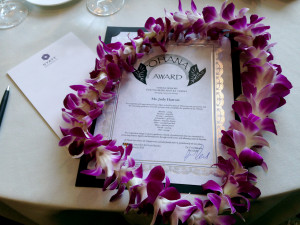
Judy_Harrow_Award_Photo_CleanHolli Emore, Executive Director of Cherry Hill Seminary, had this to say: Ms. Harrow was crucial to the development of Cherry Hill Seminary early on, building our pastoral counseling department into a program which would meet professional standards as well as the needs of the growing Pagan community.  She was also a dedicated mentor and advisor to countless individuals over the years, myself included.  To see Ms. Harrow recognized by her peers is most gratifying for our Cherry Hill Seminary family.

Macha NightMare, well-known author & past president of CHS said: Judy and I have collaborated in efforts on behalf of Pagans and Paganism since the early 1980s. She had a sharp and nuanced mind and an unwavering commitment to justice. It was Judy’s commitment to Pagans in the military that convinced me that Cherry Hill Seminary should seek full accreditation.  I’m delighted to see her life and her work acknowledged with this award.

Ms. Harrow’s award is to be housed at the New Alexandrian Library (NAL), a state-of-the-art university-quality research and lending library in Georgetown, DE dedicated to the preservation of Pagan books, periodicals, newsletters, music, media, art works, artifacts, photographs, and digital media.

According to Michael G. Smith, an Elder of the Assembly of the Sacred Wheel and Treasurer of the Board of Trustees: Ms. Harrow was an avid supporter of the New Alexandrian Library. She recognized the need for the Contemporary Paganism to preserve its history and cultural artifacts for future generations so they would be able to have a greater appreciation and understand their roots, their beginnings. She felt so passionately that she left her personal library in her last will and testament to the NAL. It is a great pleasure for us to see her work celebrated by her colleagues and we are honored to house her award, along with her collection, at the Library.

Contemporary Paganism (of which Wicca is a large component) is an umbrella term for one of the fastest growing religious movements.  Pagans are frequently interested in connection with cycles and seasons of the earth, magic, polytheism, and direct personal celebration of ritual connection to the Divine.  They tend to believe in the immanence of deity, maintain a focus on the here and now rather than an after-life, and believe the earth to be sacred.  Current numbers in the USA are pushing upwards of 1 million participants, and so media, library, university, and other institutions that serve Paganism are gaining increasing national prominence.  More information and links to some of the many paths of Paganism can be found at http://www.pagantherapy.com/what-is-neo-paganism/

The Counselors for Social Justice is an ACA division devoted to promoting “social justice in our society through confronting oppressive systems of power and privilege that affect professional counselors and our clients”.  More information at http://counseling-csj.org/

About The New Alexandrian Library (NAL): The NAL is a state-of-the-art university-quality research and lending library in Georgetown, DE dedicated to the preservation of Pagan books, periodicals, newsletters, music, media, art works, artifacts, photographs, and digital media.  More information available at http://www.sacredwheel.org/new-alexandrian-library.html .

About Cherry Hill Seminary (CHS): CHS is the leading provider of education and practical training in leadership, ministry, and personal growth in Pagan and Nature-Based spiritualties.  CHS offers Master’s degrees in Divinity, Pagan Ministry, Pagan Pastoral Counseling, and Pagan Studies; as well as certificate programs and Insights short courses for the public.  More information available at https://staging.cherryhillseminary.org .
###
CHS Announces Release of Pagan Life Academy for Incarcerated Pagans

CHS Announces Release of Pagan Life Academy for Incarcerated Pagans

For Immediate Release:  October 15, 2013

Contact: Holli Emore, 888-503-4131, CHS@cherryhillseminary.org

COLUMBIA, S.C. – Cherry Hill Seminary has just released its new Pagan Life Academy, a series of eight low-cost print lessons for incarcerated Pagans.

The Pagan Life Academy series is pan-Pagan, presenting values, ethics, stories and ritual elements that are common to various Pagan traditions.  Each lesson uses elements common to nearly all modern Paganisms:  holidays, the calling of directions, ritual practice, and mythology.  Because inmates are incarcerated most often because they have made poor choices, our writer chose eight character traits, or virtues, and re-wrote stories from ancient cultures to emphasize these virtues.  The ritual actions are based on the stories and include a commitment to continuing the development of a given virtue.  Pagan Life Academy lessons are suitable for solitary practitioners, or for groups, and for use by volunteers and chaplains in prison systems.

“As America’s prisons become increasingly crowded they more nearly reflect the changing religious demographics of our country, which include growing numbers of Pagans, and SBNRs (‘spiritual but not religious’).  The prison experience can be a cauldron of transformation for many;  Pagan Life Academy is Cherry Hill Seminary’s offering to our incarcerated Pagans and those who serve them,” said Executive Director Holli Emore.

The following lessons may be ordered online at https://staging.cherryhillseminary.org/students/degree-programs/pagan-life-academy-incarcerated-pagans/, or by sending a check or money order to Cherry Hill Seminary, P.O. Box 5405, Columbia, SC 29250.


Lesson

Item Cost

Samhain, Winter Nights, Halloween – October 31Persephone and the Pomegranate; truthfulness and integrity

$5

Yule, Midwinter, Winter Solstice – December 21 or 22The Devotion of Isis to Osiris; devotion and loyalty

$5

Imbolc, Disting, Candlemas – February 1The Commitment of Mulan; commitment and following through

$5

Ostara, Summer Finding, Spring Equinox – March 20 or 21The Land Spirits and the Maple Syrup; substance abuse, meaningful work, goal-setting

$5

Beltane, Mayday – May 1The Binding of Fenris; courage, sacrifice, responsibility

$5

Litha, Midsummer, Summer Solstice – June 21 or 22The Children of Hercules are Offered Compassion; empathy and compassion

$5

Lammas, Lughnasadh, Freyfraxi – August 1The Generosity of Baucis and Philemon; generosity and helping

$5

Mabon, Harvest, Fall Equinox – September 22 or 23Fionn and the Song of Fairie; self-control, risk, endurance, and honor

$5

Welcome and IntroductionYou will need one of these to go with the lessons – ritual instructions, how to use the stories and discussion guides, individual roles, altar setup, directions, correspondences

$3

For more information, visit Cherry Hill Seminary online (https://staging.cherryhillseminary.org/students/degree-programs/pagan-life-academy-incarcerated-pagans/).

Scholarship Endowment Gift A Challenge To Others

For Release: June 1, 2013

COLUMBIA – Cherry Hill Seminary has received a generous gift of $10,000 to endow a scholarship for graduate students. The anonymous donor has made the gift a matching challenge to others who support Cherry Hill Seminary’s mission of quality education and practical training in leadership, ministry, and personal growth in Pagan and Nature-Based spiritualities. Interest from the endowment will provide an annual scholarship to a master’s intensive, two of which are required in order to complete a Master of Divinity degree.

“Not only are we grateful for the foresight of this donor, who has demonstrated such admirable commitment, but we also applaud those who have already taken advantage of this opportunity to, in effect, double their own gift by responding to the matching challenge,” said Dr. Todd Berntson, President of Cherry Hill Seminary.

Executive Director Holli Emore noted that the donor was inspired to give by the recent Sacred Lands and Spiritual Landscapes held in collaboration with the University of South Carolina. “We have worked so hard for the past several years to shape our program into one with strong academic integrity as well as meaningful impact for the community of Pagan and nature-based spiritualities,” said Emore. This endowment is both an affirmation of that hard work, and a signal to others who might be ready to join the effort.”

Nearly $3,000 in gifts to the endowment have already been received; Cherry Hill Seminary has until July 1, 2013 to raise the full $10,000 match.

Those who wish to make a gift may do so online or mail their check to Cherry Hill Seminary, P.O. Box 5405, Columbia, SC 29250-5405.

Pledges may be made online here or by emailing your message to CHS @ cherryhillseminary.org. All donors will be acknowledged online unless they request otherwise.

Those interested in a future scholarship may write Cherry Hill Seminary for more information, or watch future newsletters for announcement of an invitation to apply. Donors may make a pledge to pay any time before December 31, 2013.

For more information, contact Holli Emore at Cherry Hill Seminary at CHS @ cherryhillseminary.org.

Ronald Hutton Speaks to Cherry Hill Seminary

Interview with Holli Emore: Saturday, April 20, 2013

Hutton2Why is the history of witchcraft or any kind of paganism important to contemporary practitioners?

For two reasons. The first is that modern witchcraft and pagansim were based on claims about the past, specifically with regards to the survival of a tradition. The second, because they both represent the revival of an ancient tradition or traditions, they must look to ancient ideas and images for at least part of their inspiration.

Will you say more about this statement from your 2010 article for The Pomegranate?
“Religions have, of course, very commonly divided into sects over the interpretation of texts, but the latter are normally the sacred writings of the religious tradition concerned. Modern Paganism lacks such scriptures, and instead different publications on the historic past are coming to fill their space.”

It really is very unusual and a little unnerving to find books by professional historians treated with the same interest by practitioners of a religion as is normally given to the alleged words of deities or of prophets. It is also very flattering; but we perhaps need to place less stress on the past and more on virtues of religion as people actually live it.

In the same article you state that you had hoped Triumph readers, especially practitioners outside the academy, would delve into the sources you had cited, e.g., 19th- and 20th-century writers like Forrest Reid. How might rising scholars and independent scholars contribute in a meaningful way to this stream of research?

There is a quite wonderful mine of material for modern Pagans in the literature of the past 200 years. It includes writers, some very well known, and some not, who both had an intensely affectionate relationship with ancient paganism themselves and directly helped to inspire modern Paganism. These works are in publication and in English and so very accessible to English-speaking readers outside of the academy. They provide both wonderful poetry and prose for use in ritual and in one’s own sense of religion, and also a sense of direct kinship with ancestors who can beyond doubt be claimed as part of the history of modern Paganism.

You spoke of the need for society to “let us do our work,” e.g., preventing politics or the trends of academia to overrule actual research. What is lost when this happens, or what has been lost when this has occurred in your career?

The healthiest situation for both the producers and the consumers of research is one in which all parties recognize that the past can often be interpreted in different ways; and that a range of different interpretations is a healthy situation, especially in a modern society made up of individuals, rather than a regrettable situation. In my address, I drew attention to the example of the bog body called Lindow Man, in the British Museum, which had been interpreted as proof of the existence of human sacrifice in ancient Britain. I played a significant part, myself, in a discussion which succeeded in achieving a recognition that the interpretation of human sacrifice was only one of a number that could be applied to the body.

Will you explain for our readers why you said, “We are the only society that both believes in witchcraft and doesn’t believe in it, and I’d like to keep it that way.”

My actual statement was, We are the only society in history which has both believed strongly in witchcraft, and spontaneously ceased to believe in it. I would like it to continue officially to disbelieve in witchcraft, because people who call themselves witches can only really be safe in a society which doesn’t believe in them. By this I am not suggesting that modern witches should stay in the broom closet. What I am suggesting is that they will have a far easier time out of the closet if they define what they are doing as a religion rather than trying to convince people that they possess actual magical powers.

You have shown an extraordinary sensitivity to the reactivity to your work of contemporary Pagans. Cherry Hill Seminary – as a seminary – is in a unique position of educating people who then may function as bridges between the academy and the average Pagan. What advice would you give those who study your work and then disseminate, really sort of pre-digest it, for the non-academic Pagan?

I would advise Pagans to become less worried about history altogether and more concerned with achieving living relationships with their deities and providing wonderful experiences in ritual for their fellow humans.